
It’s important for all businesses to have systems in place to determine whether workers
should be classified as employees or independent contractors, as tax, super and other
government obligations are different depending on whether the working arrangement is
employment or contracting.
Employees generally have PAYG withholding, super and fringe benefits tax paid by the
employer. Contractors generally look after their own tax obligations.
If you get it wrong and fail to meet your obligations, you risk having to pay penalties and
charges.
What factors do you need to consider?
There are a number of factors which need to be taken into account which help determine
whether a worker could be classed as an employee or an independent contractor.
It is important to realise that no single factor can determine if a person is an independent
contractor or an employee. To correctly determine whether a worker is an employee or
contractor, you need to look at the whole working arrangement.
A worker isn’t automatically a contractor just because they have an ABN or specialist
skills or you only need them during busy periods.
Courts will look at the whole relationship between the parties when determining the
status of a person’s employment.
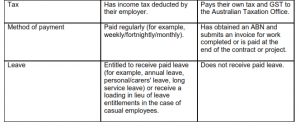
The Fair Work Ombudsman has produced a table of common indicators that may
contribute to determining whether a person is an employee or independent contractor:


A simple way to help tell the difference
The Australian Taxation Office on its website uses the following simple descriptions:
• Employees work in your business and are part of your business.
• Contractors run their own business and provide services to your business.
Why is the distinction important?
Employment relationships are regulated by specific labour protection laws and various
awards and workplace agreements. These laws generally provide a higher degree of
protection to employees than the general commercial laws that regulate contractor
relationships.
This protection includes minimum conditions and standards of employment for
employees including minimum entitlements for leave, public holidays, notice of
termination and redundancy pay.
Adopt good business processes
Business owners need to keep records to support any decision on whether a worker is
an employee or contractor and the factors relied on to make that decision.
Most of the information needed to support the decision can be found in a service
contract for independent contractors or an employment contract for employees, which
should accurately reflect the actual conditions of the working arrangement.
All contracts should:
• be in writing
• specify whether it is a contract for services or an employment contract;
• set out the period of engagement and the remuneration;
• include dispute resolution provisions;
• specify if/how the relationship can be terminated.
Penalties
It is illegal for an employer to misrepresent an employment relationship or a proposed
employment arrangement as an independent contracting arrangement or make a
knowingly false statement to persuade or influence an employee to become an
independent contractor.
Under the Fair Work Act inspectors can:
• seek the imposition of penalties for contraventions of sham contracting
arrangements.
• apply to the courts to grant an injunction or an interim injunction if an employer
seeks (or threatens) to dismiss an employee for the purpose of engaging them as
an independent contractor. The purpose of the injunction would be to prevent the
dismissal from occurring, or otherwise remedy the effects. Courts can also make
other orders to have the employee reinstated or compensated.
If you need more information or if you need assistance or advice on how to proceed
please call us on (03) 9600 0162 or email info@lordlaw.com.au.